Amyah Kept Her Grip, and Now She Holds the Keys
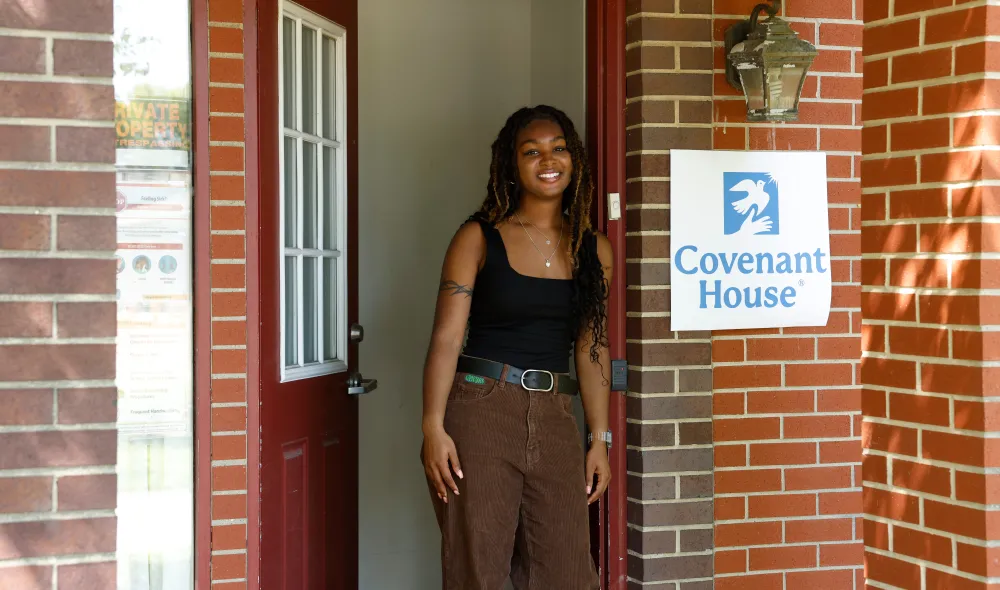
Amyah first heard about Covenant House at a poetry open mic.
She met a fellow poet there who had lived through homelessness too. That poet had stayed at Covenant House California, moved into an apartment in one of its affordable-for-youth housing communities, and was now working as an engineer. Amyah was stunned. She hadn't known a place like that existed.
Not long after, she pulled into CHC's Safe Haven shelter in Los Angeles with, in her words, "$30 to my name and enough gas to get here."
The years before
Amyah was 16 when she was forced out of her home because of her sexual orientation. For the next several years, she stayed wherever she could. She slept on friends' couches. When there was no couch, she slept in her car. It is a kind of hidden homelessness that is common among young people, and one that often goes uncounted.
"When you feel things crumbling in your life, it is a little bit hard to keep your grip sometimes," Amyah said.
Again and again, she has had to decide what her circumstances would make of her. "Like, 'okay, are you going to get depressed, are you going to curdle, are you going to become aligned ultimately with your situation and let it overtake you?'" she said. "But I think that, thank God, the more hurdles that I experience, I become more fiercely determined to have a happy ending."
Sixty-hour weeks
Amyah has never been afraid of work. Over the years she has held many jobs, including one at a Tesla factory and another at Universal Studios, a position she found through CHC's Career Center. While staying at CHC, she pushed herself to 60-hour weeks to reach her financial goals.
For young people leaving homelessness, though, hard work and a paycheck are often not enough to open the door to an apartment. Affordable housing has traditionally been defined by Area Median Income (AMI), a federal measure. Yet even at 50% of AMI, rent in most U.S. cities can be out of reach for a young person earning an entry-level wage. Security deposits are another wall. A past marked by homelessness can bring quiet discrimination from landlords. Even young people with jobs, savings, and people in their corner can struggle to find a home and keep it.
A different kind of affordable
That gap is exactly what affordable-for-youth housing is built to close.
Covenant House defines affordable-for-youth housing around what young people actually earn. Rent is set at roughly a third of a full-time income, even at minimum wage. Each apartment is an independent home, with no mandatory on-site services. There is no enforced time limit, though most residents are expected to stay three to five years while they build savings, credit, and careers.
The spaces are clean, safe, and dignified, and they are designed to grow community and a sense of belonging. They are also open to any young person who has experienced homelessness, whether or not they ever stayed at Covenant House.
In October 2023, CHC opened Linden Commons, Covenant House's first affordable-for-youth housing community. Its 12 studio apartments were designed with young renters in mind, and residents can still take a short bus ride to CHC's main campus for meals and mental health services.
Olive Tree Commons followed in November 2024 with 16 more units. CHC purchased the building in 2019 and renovated it entirely with private funds. Residents' modest rents cover building maintenance and services, so the property is designed to sustain itself, and to serve as a model other communities can follow.
A key of her own
Just one year after arriving at CHC, Amyah moved into her own apartment at Olive Tree Commons.
What she found there were neighbors who understood. Even the property manager, Derrick, once stayed at Covenant House. "He's extremely helpful," she said. "It's cool to be surrounded by other people who have similar experiences but also have overcome those experiences."
Still writing
Today, Amyah works as a Registered Behavior Technician, supporting elementary school students with autism and developmental disabilities in their classrooms. Lately she has been reflecting on how far she has come, and she is already looking ahead. She plans to become a dietitian. She also wants to create open mic nights for underprivileged artists and grow them across Southern California.
It fits. An open mic is where Amyah first learned that a door like this could open. Somewhere in a room full of poets, there may be a young person who slept in a car last night, listening to someone who has been there and found a way home.
Soon, that someone could be Amyah.
__________
Young people like Amyah deserve more than a temporary place to stay. Your gift helps Covenant House provide safety, opportunity, and affordable-for-youth housing where young people can build stability and independence.
Get news, stories, and insights delivered right to your inbox.

Help Build Brighter Futures for Our Youth
Your gift today provides services and support to young people on their journey toward sustainable independence and a hope-filled future.