One Movement, One Day: Covenant House Goes to Capitol Hill
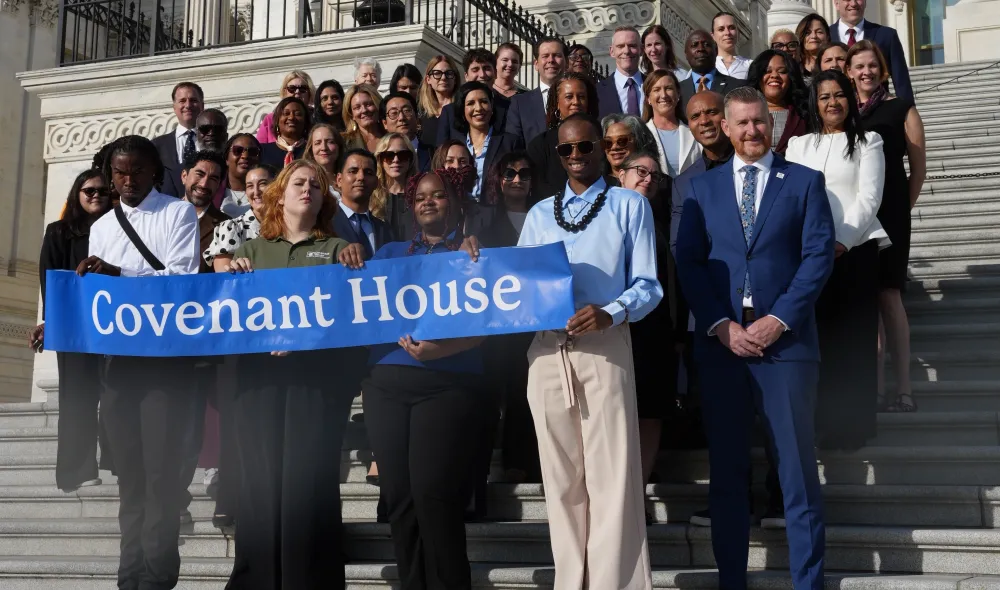
On Thursday, Oct. 1, Covenant House advocates walked the halls of Congress with something more than a list of requests. We brought the voices of the young people we serve, evidence of our more than five decades of work, and a clear conviction: Ending youth homelessness is not the work of one shelter, one city, or one country. It is the work of a movement.
More than 50 advocates comprised of young people, site leaders, board members, and staff from across our 34-city federation visited congressional offices in a single day. In between meetings on the Hill, our leadership also sat down with federal partners at the Administration for Children and Families (ACF), the agency within the U.S. Department of Health and Human Services that oversees programs for children, youth, and families.
Why We Went: For the Movement, Not Just One Program
Most advocacy days are built around a single program or a single funding line. This one was different by design. It was not a protest, and it was not a fundraiser. It was a working day. Every advocate who walked into a congressional office spoke on behalf of the whole Covenant House federation including every site, and every young person still waiting for a bed.
That meant a delegate from one city could speak with confidence about a site hundreds of miles away. It meant young people carrying not only their own experiences but the stories of peers who trusted us to share them. And it meant our priorities for our Latin America sites sat right alongside our priorities at home, because the children we serve in Guatemala, Honduras, and Mexico are part of the same promise.
To prepare, advocates learned to speak from three places at once: the head (the facts and the policy), the heart (a real young person's story), and the hand (one clear ask of the person across the table).
What We Asked For: Five Priorities
- Ending youth homelessness. We asked Congress to protect and strengthen youth homelessness funding through the U.S. Department of Housing and Urban Development, including the local Continuum of Care systems that connect young people to shelter and housing.
- Expanding safe and affordable housing. Leaving a shelter is not the finish line. Young people need somewhere stable to go next. We asked lawmakers to support affordable-for-youth housing (AFYH) and the federal tools that make it possible: the Low-Income Housing Tax Credit, the HOME Investment Partnerships Program, and Community Development Block Grants. Most affordable housing is priced against area median income. A young person a few years out of homelessness rarely earns anywhere near that, and often has no rental history, co-signer, or credit score. AFYH is built around what a young adult actually earns, with the support that helps a first lease last.
- Protecting youth from human trafficking. We asked Congress to reauthorize the Runaway and Homeless Youth and Trafficking Prevention Act (RHYTPA), which funds both services for young people experiencing homelessness and trafficking prevention, and to support the Victims of Crime Act (VOCA), which funds the advocates and counselors who stand beside survivors.
- Protecting children and youth across Latin America. At our sites in Mexico, Guatemala, and Honduras, Covenant House serves young people between 12 and 18 years old, and sometimes younger. Staff members from Latin America joined the delegation to speak to our anti-trafficking work across the Americas. We asked lawmakers to advance the Trafficking Victims Protection Reauthorization Act (TVPRA) and to protect funding for youth protection programs in Central America. Human trafficking often crosses borders, and the promise we make to a child in Tegucigalpa is the same one we make in New York.
- Directing congressional appropriations. A law can exist and still receive zero dollars. Appropriations is how Congress turns promises into programs, and every other priority on this list depends on it. Communities across the country are searching for what works to end youth homelessness. Covenant House brings the experience and evidence to help direct those dollars where they will do the most good.
Beyond the Hill: Partnering with the Administration for Children and Families
Some of the day's most important conversations happened at ACF, the federal agency that oversees programs serving runaway and homeless youth and young people leaving foster care.
Bill Bedrossian, president and CEO of Covenant House International, met with ACF leaders about a gap too many young people fall through: the moment they age out of foster care.
"We talked about the intersection between foster care exits and homelessness, and our ability to really coordinate to prevent some of that from happening, ensuring that young people coming out of foster care have more stability than they currently have,” Bill shared.
Samantha Calero, senior vice president of advocacy and strategic partnerships, met with the ACF team that leads human trafficking prevention and research, and shared The Journey Home, Covenant House International's strategic plan to end youth homelessness as we know it.
"We had the opportunity to meet the team at ACF that leads their human trafficking prevention and research work. We talked about The Journey Home and really got in depth on how human trafficking is both a risk factor and a consequence of youth homelessness, and what we can do in partnership to address these issues."
That insight sits at the center of our work. Homelessness leaves young people exposed to people who would exploit them, and trafficking can push young people out of safe homes and into the streets. Breaking that cycle takes partners at every level, from the shelter door to federal agencies.
The Young People Who Carried the Message
The most powerful voices in the room belonged to young people. Members of our International Youth Congress as well as Youth Ambassadors from Covenant House New York traveled to Washington to sit across from lawmakers and their staff.
They prepared for weeks to speak to the policy itself, what the Runaway and Homeless Youth Act funds, why a housing tax credit matters to a 19-year-old, and how a single appropriations line can decide whether a bed exists.
Some shared their own experiences. Others chose to carry the published stories of peers from our sites, honoring young people who could not be in the room. Every one of them walked into every meeting with a Covenant House staff member beside them.
Their presence changed the conversation. A statistic can be set aside, but a young person who has lived what that statistic describes, and who can name exactly what Congress should do about it, cannot.
What Comes Next
Hill Day was one day. The work it began does not end with it. Our advocacy team will follow up with every office we visited, and after the November elections, we will work alongside our sites to shape the Covenant House advocacy agenda for the 120th Congress.
“Advocacy is not one day in October,” said Samantha. “It is showing up again in March, when no one is watching, and again and again after that.”
You can stand with us right now:
- Contact your members of Congress. Ask them to protect funding for young people experiencing homelessness and trafficking.
- Learn more about our policy priorities.
- Give. Every gift helps keep a door open for a young person tonight.
The young people who came to Washington showed lawmakers what perseverance looks like. Now it is our turn to make sure Congress keeps its promise to them.
_____
Explore Covenant House’s advocacy work and learn how you can help advance policies that support young people experiencing homelessness.
Get news, stories, and insights delivered right to your inbox.
You Might Also Like...
All news & insights
Help Build Brighter Futures for Our Youth
Your gift today provides services and support to young people on their journey toward sustainable independence and a hope-filled future.